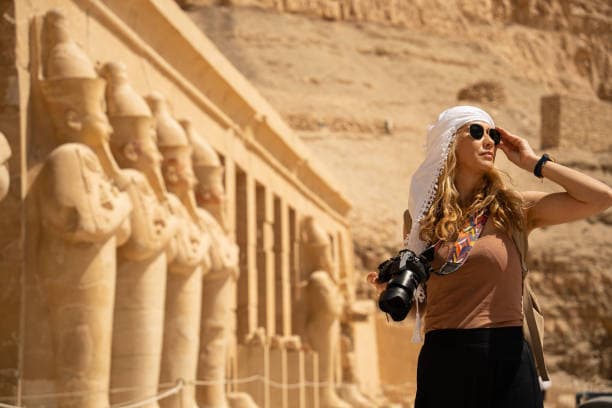
Temple of Hatshepsut Guide 2026: Explore Egypt's Most Beautiful Mortuary Temple

Temple of Hatshepsut Guide: Egypt's Most Extraordinary Royal Monument
Nestled beneath the towering limestone cliffs of Deir el-Bahari on Luxor's West Bank, the Temple of Hatshepsut is one of the greatest architectural masterpieces of ancient Egypt. Built more than 3,400 years ago, this magnificent temple honors Queen Hatshepsut, one of Egypt's most successful and influential rulers.
Unlike traditional Egyptian temples, Hatshepsut's mortuary temple features elegant terraces, graceful colonnades, and a design that blends perfectly with the surrounding cliffs. Its unique appearance and remarkable preservation make it one of the most photographed landmarks in Egypt.
Whether you are fascinated by history, architecture, or archaeology, a visit to the Temple of Hatshepsut is an essential part of any Luxor itinerary.
Why Visit the Temple of Hatshepsut?
The Temple of Hatshepsut is one of Egypt's most iconic monuments.
Reasons to visit include:
Discover the story of Egypt's greatest female pharaoh
Admire one of the world's finest examples of ancient architecture
Explore beautifully preserved reliefs
Learn about ancient trade expeditions
Enjoy breathtaking views of the Theban Mountains
Visit one of Luxor's UNESCO World Heritage Sites
The temple offers an unforgettable combination of history, art, and natural beauty.
Who Was Queen Hatshepsut?
Hatshepsut ruled Egypt during the 18th Dynasty and became one of the few women to reign as pharaoh.
Her reign was marked by:
Peace and stability
Major construction projects
Economic prosperity
International trade
Expansion of temples throughout Egypt
To strengthen her authority, Hatshepsut often depicted herself wearing the traditional royal beard and crown of a male pharaoh while emphasizing her divine right to rule.
Today, she is remembered as one of ancient Egypt's greatest leaders.
History of the Temple
Construction began around 1479 BC and took approximately 15 years to complete.
The temple was designed by Senenmut, Hatshepsut's trusted architect and advisor.
It served several important purposes:
A mortuary temple honoring Hatshepsut
A center for religious ceremonies
A place to worship the god Amun
A monument celebrating the queen's achievements
After Hatshepsut's death, parts of the temple were intentionally damaged by later rulers attempting to erase her legacy.
Modern archaeological restoration has carefully preserved and reconstructed much of this extraordinary monument.
The Three Terraces
One of the temple's most distinctive features is its three magnificent terraces connected by long central ramps.
Each terrace contains:
Elegant colonnades
Statues of Hatshepsut
Beautiful relief carvings
Sacred shrines
The perfectly symmetrical design creates one of the most harmonious architectural compositions in ancient Egypt.
The Punt Expedition Reliefs
Among the temple's most famous carvings are the reliefs depicting Hatshepsut's expedition to the mysterious Land of Punt.
These detailed scenes show:
Egyptian trading ships
Exotic animals
Incense trees
Gold
Ivory
Rare goods
The expedition demonstrated Egypt's wealth and international influence during Hatshepsut's reign.
These reliefs remain one of the earliest known visual records of international trade.
Chapel of Hathor
The Temple of Hathor honors the goddess associated with:
Love
Beauty
Music
Motherhood
The chapel features elegant columns decorated with Hathor-headed capitals and beautifully carved reliefs.
Chapel of Anubis
Dedicated to Anubis, the ancient Egyptian god of embalming and the afterlife, this chapel contains remarkably preserved carvings and colorful decorations.
It provides valuable insight into Egyptian funerary beliefs and religious practices.
Sanctuary of Amun
The sanctuary was one of the temple's most sacred spaces.
During important festivals, priests carried the sacred barque of Amun from Karnak Temple to this sanctuary as part of religious ceremonies celebrating the divine connection between the king and the gods.
Architecture
The Temple of Hatshepsut is considered one of the greatest achievements of ancient Egyptian architecture.
Its design is remarkable because:
It blends naturally into the surrounding cliffs.
The terraces create perfect symmetry.
Massive limestone columns support open courtyards.
Detailed reliefs cover many walls.
The temple demonstrates advanced engineering for its time.
Its influence can still be seen in modern architecture around the world.
Photography Tips
The Temple of Hatshepsut offers outstanding photography opportunities.
Best locations include:
The central ramps
Upper terraces
Limestone cliffs
Colonnades
Panorama overlooking the temple
Sunrise lighting
Early morning provides the best conditions for photography.
Best Time to Visit
The ideal months are:
October
November
December
January
February
March
April
Morning visits are recommended to avoid heat and enjoy softer lighting.
Suggested Visit Plan
A typical visit lasts 1.5–2 hours.
Recommended route:
Visitor entrance
Lower terrace
Middle terrace
Punt Expedition Reliefs
Chapel of Hathor
Chapel of Anubis
Upper Terrace
Sanctuary of Amun
Scenic viewpoint
Nearby Attractions
Combine your visit with:
Valley of the Kings
Valley of the Queens
Colossi of Memnon
Medinet Habu Temple
Ramesseum
Tombs of the Nobles
These attractions are all located on Luxor's West Bank and can easily be explored in one full day.
Travel Tips
Wear comfortable walking shoes.
Bring sunscreen and plenty of water.
Visit early in the morning.
Respect archaeological preservation rules.
Hire a licensed Egyptologist guide to fully appreciate the temple's history.
Why Choose Black Pyramids Tours?
At Black Pyramids Tours, we offer expertly guided visits to the Temple of Hatshepsut, allowing you to experience one of Egypt's greatest monuments with the insight of professional Egyptologists.
Our tours include:
Hotel pickup and drop-off
Licensed Egyptologist guide
Air-conditioned transportation
Private and group tour options
Flexible itineraries
Combination tours with the Valley of the Kings and other West Bank attractions
Our goal is to provide every traveler with a comfortable, educational, and memorable experience.
Frequently Asked Questions
Why is the Temple of Hatshepsut famous?
It is famous for its unique terraced architecture, spectacular location beneath the cliffs of Deir el-Bahari, and its association with Queen Hatshepsut, one of ancient Egypt's most successful rulers.
How long should I spend at the temple?
Most visitors spend 1.5 to 2 hours exploring the site.
Who designed the Temple of Hatshepsut?
The temple was designed by Senenmut, the queen's chief architect and advisor.
Is the Temple of Hatshepsut worth visiting?
Absolutely. It is one of Egypt's finest architectural masterpieces and a highlight of any Luxor tour.
Can I visit the Temple of Hatshepsut and the Valley of the Kings on the same day?
Yes. These attractions are located close together and are commonly included in the same West Bank itinerary.
Book Your Temple of Hatshepsut Tour Today
Discover the extraordinary legacy of Egypt's greatest female pharaoh as you explore one of the world's most beautiful ancient temples. Walk through elegant terraces, admire remarkable reliefs, and uncover the stories of Queen Hatshepsut's remarkable reign.
Book your Temple of Hatshepsut Tour with Black Pyramids Tours today and experience one of Luxor's most iconic landmarks with expert guides, premium service, and unforgettable memories.
Options de voyage recommandées:
Experience this destination firsthand
We organise private bespoke luxury tours matching the history and discoveries highlighted in this article.